Earth
Vainqueur the DragonEarth is the absent homeworld that gives the story’s cosmology its scale and its central danger. For Victor Dalton, it is the place of his former life, the world he desperately wants to recover after death and forced reincarnation. For the fomors, it is also the nest they intend to invade once they have reconquered Outremonde, making Earth both a personal destination and the ultimate theater of an approaching war.
A Modern World Beyond Outremonde
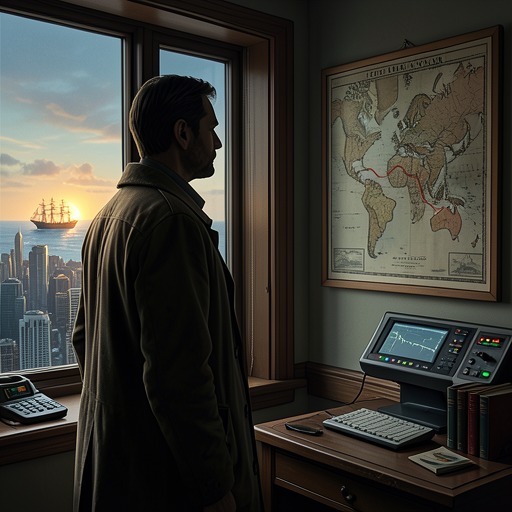
Earth is introduced through contrast. Mithras explains that Outremonde is one world among many and that Earth has a twin: a realm similar in shape but transformed by dragons and magic rather than planes and science. The comparison establishes Earth as recognizably modern without treating it as the universal norm. In Outremonde, dragons occupy the skies, magic replaces technological systems, and a great blight threatens civilization; Earth represents the different historical and material order from which several reincarnated humans originate.
The distinction also gives Earth an important structural function. It is not merely a distant planet named in passing, but the reference point through which characters understand the strangeness of Outremonde. The gods describe the two worlds as parallel rather than wholly unrelated, while the possibility of passage between them turns the setting’s fantasy premise into a transworld conflict. Earth’s existence proves that Outremonde is part of a wider cosmos, not an isolated stage.
Victor Dalton’s Lost Home
Victor Dalton identifies himself as coming from America, then clarifies that America belongs to Earth. His admission follows a dangerous exchange in which a marquise has already noticed that his accent is not Gardemagnian and sounds vaguely Prydanian. Because the Fomors of Prydain have fought bloody wars against Gardemagne and still attack ships approaching their island, Victor understands that his origin is not safe information to display carelessly. Earth is therefore connected to his identity, but announcing that identity exposes him to suspicion in Outremonde’s political world.
Victor’s relationship with Earth is defined by resentment as much as longing. He remembers dying on Earth after rescuing a girl he had a crush on from a mugging; he was stabbed and left bleeding in an alley. Reincarnation did not make that death feel meaningful to him. Instead, he awoke to a world of brigands, man-eating monsters, and dragons, where he had gone months without a hot bath and was then forced to join a band of outlaws in order to survive. Earth consequently functions as a lost ordinary life whose comforts become vivid only after their removal.
His practical ambitions are deliberately smaller than the heroic destiny assigned to him. Victor has no interest in becoming a hero or a local curiosity. He wants to survive, have sex, and return home. That wish makes Earth the direction of his private future even while Outremonde repeatedly claims his labor, allegiance, and danger. His otherworldly status is not initially a source of wonder for him; it is an unwanted displacement from which he hopes to escape.
The Gate and the Fomor Design
Earth’s importance becomes more ominous when Lucie Lavere encounters the hidden chamber of Mell Odieuse. Mell Odieuse sits upon a throne of black, cursed wood, holding the Apple of Knowledge while an immense stone gate stands behind her. The gate is described as the greatest and most secret treasure of the fomors, and Lucie sees Mell Odieuse glance toward it before departing. The following revelation identifies the destination beyond that architecture directly: the gate leads to the strange world called Earth.
This discovery changes Earth from a remembered homeland into a material strategic asset. The world is not simply unreachable background; the fomors possess, or at least guard, a means of access. Mell Odieuse’s position behind the gate links knowledge, forbidden magic, and interworld movement. Her Apple of Knowledge and the sealed gateway together suggest that Earth is embedded in the fomors’ oldest secrets rather than discovered by the contemporary powers of Outremonde.
The secrecy of the gate also explains why Earth has such a charged place in the narrative. Victor’s desire to return home is personal and immediate, while Mell Odieuse’s relation to the gateway is coldly instrumental. The same world can therefore signify refuge to one displaced human and an object of power to an ancient enemy. The contrast prevents Earth from becoming a simple symbol of safety: access to it is controlled by forces that may use the world for domination.
The Planned Invasion
The fomors’ larger program makes Earth the final objective of a war that begins in Outremonde. A fomor tells Vainqueur Knightsbane that a great Wild Hunt is being assembled, a horde numbering in the millions. Its stated purpose is to spill the blood of mortals until the last of them has been slain. Only after that devastation will the force carry its war to the mortals’ nest, the world called Earth.
The invasion plan is explicitly framed as restoration. The fomors claim that Outremonde belonged to the Old Folk during ancient days and that they will make it theirs again. Earth is the next target because humanity is understood not as a separate population with its own legitimate home, but as an extension of the manling presence that defeated the fomors in Outremonde. Their language collapses conquest, revenge, and historical reclamation into one campaign.
Vainqueur rejects the invitation to participate. He asserts that he has always ruled and argues that the fomors, rather than dragons, became weak enough to be defeated by manlings. His response places Earth within the rivalry between older nonhuman powers and humans, but it also denies the fomors’ claim to exclusive antiquity. The exchange reveals that Earth’s threatened invasion is not an isolated military operation: it is the projected continuation of an ancient struggle over who has the right to rule both worlds.
Narrative Significance
Earth organizes the book’s movement between ordinary life, fantasy estrangement, and imperial threat. Its modernity supplies the baseline against which Outremonde’s dragons and magic are measured; Victor Dalton’s memories make that contrast intimate; the secret gate makes it physically reachable; and the Wild Hunt transforms it into the endpoint of genocidal expansion. These functions converge without resolving the tension between them.
For Victor Dalton, Earth is a home to which he wishes to return, despite the violent death that began his displacement. For the gods, it is one world among many whose people can be claimed and reincarnated for a divine war. For Mell Odieuse, it is the secret destination guarded behind stone. For the fomors, it is the nest to be conquered after Outremonde has been drenched in blood. Earth thus remains offstage while exerting pressure on nearly every level of the story: personal memory, religious doctrine, hidden architecture, and the future of civilization.